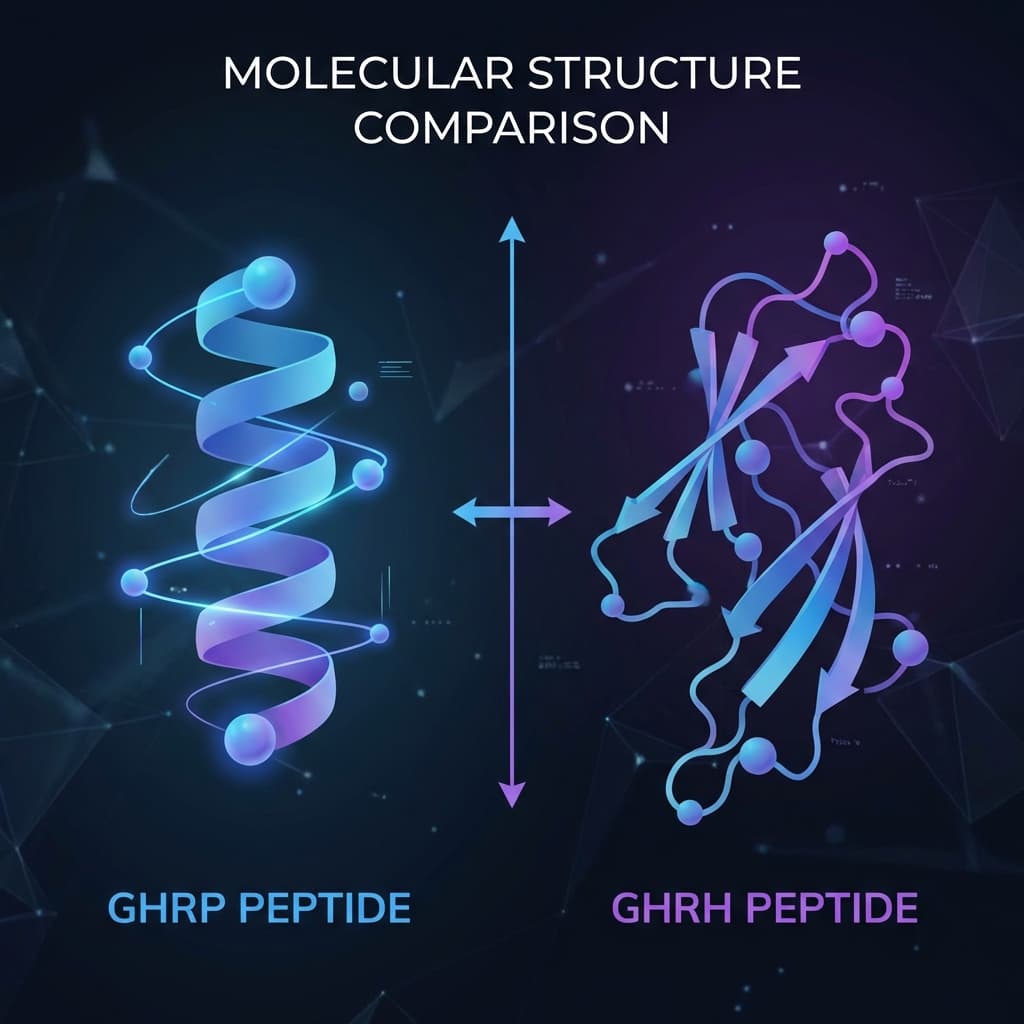
Overview of GH-Related Peptides
Both GHRP (Growth Hormone Releasing Peptides) and GHRH (Growth Hormone Releasing Hormones) are research peptides studied for their effects on the growth hormone axis. Despite similar-sounding names, they work through completely different mechanisms.
GHRH Peptides
GHRH peptides mimic the natural hypothalamic hormone that stimulates growth hormone release from the pituitary gland.
Common Research Compounds
- Sermorelin — Truncated GHRH (1-29)
- Mod GRF 1-29 — Modified for extended half-life
- CJC-1295 — Long-acting GHRH analog
Mechanism
GHRH binds to GHRH receptors on somatotroph cells in the anterior pituitary, triggering GH synthesis and release through cAMP signaling.
GHRP Peptides
GHRPs work through a completely different pathway — the ghrelin receptor system (GHS-R). They act as ghrelin mimetics.
Common Research Compounds
- GHRP-2 — Strong GH release, orexigenic signaling observed
- GHRP-6 — Strong GH release, significant orexigenic response
- Ipamorelin — Selective GH release, minimal off-target activity
- Hexarelin — Potent GH release
Mechanism
GHRPs activate ghrelin receptors, which triggers GH release through phospholipase C and protein kinase C pathways — independent of GHRH.
Key Differences Summary
- Receptor targets — GHRH receptor vs. Ghrelin receptor (GHS-R)
- Signaling pathways — cAMP vs. phospholipase C
- Effects on feeding behavior — GHRPs often stimulate orexigenic pathways; GHRH does not
- Synergy — Combining both may produce amplified effects in research
Synergistic Research
Studies have shown that combining GHRH and GHRP compounds produces significantly greater GH release than either alone, suggesting complementary mechanisms.