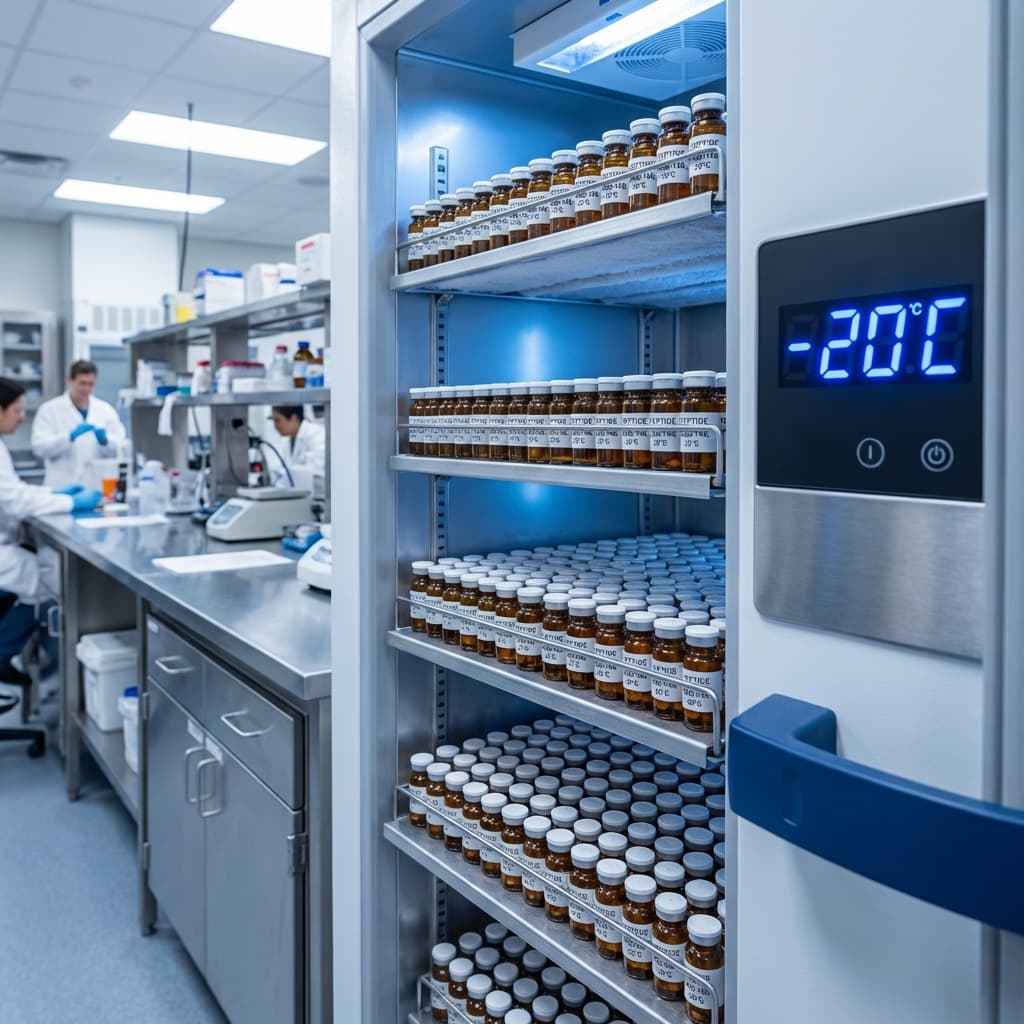
Storage Temperature Guidelines
Temperature is the most critical factor in peptide stability. Improper storage can lead to degradation, aggregation, and loss of biological activity.
Lyophilized Peptides
- Short-term (weeks) — Refrigerate at 2-8°C
- Long-term (months to years) — Freeze at -20°C or -80°C
- Extended storage — Ultra-low freezer at -80°C for maximum stability
Reconstituted Peptides
- Immediate use (days) — Refrigerate at 2-8°C
- Extended use (weeks) — Aliquot and freeze at -20°C
Avoid Freeze-Thaw Cycles
Repeated freezing and thawing damages peptides. Create single-use aliquots before freezing to preserve integrity.
Reconstitution Best Practices
Proper reconstitution technique is essential for peptide solubility and stability.
Choosing Your Solvent
- Bacteriostatic water — Best for multi-use over days/weeks
- Sterile water — For immediate single use
- Acetic acid (0.1%) — For basic peptides with solubility issues
- DMSO — Last resort for hydrophobic peptides
Technique
- Add solvent slowly along the vial wall
- Allow the peptide to dissolve naturally — avoid vigorous shaking
- Gentle swirling is acceptable to aid dissolution
- Never vortex at high speeds
Light and Moisture Protection
UV light and humidity are silent peptide killers:
- Store in original amber vials or wrap clear vials in foil
- Keep lyophilized peptides sealed until ready to use
- Allow frozen vials to reach room temperature before opening
- Use desiccants for long-term storage