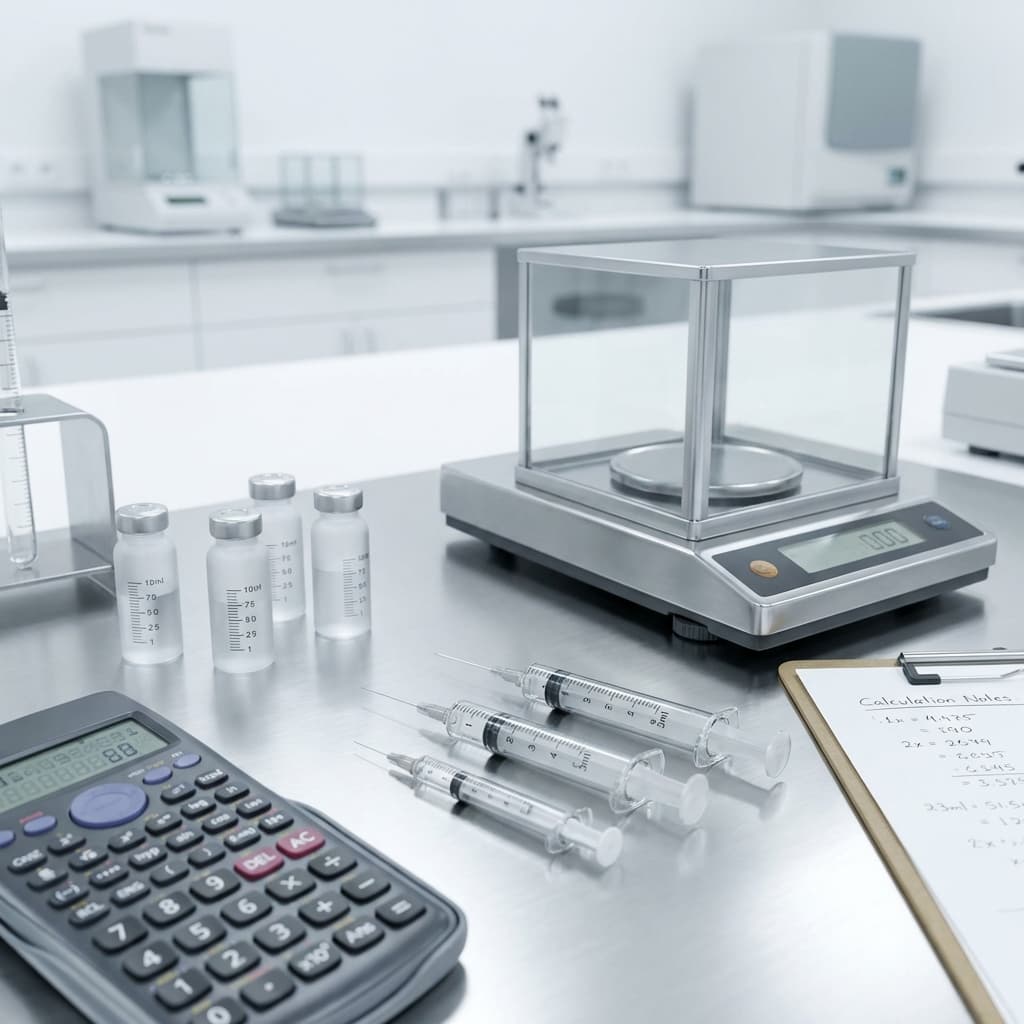
Effective peptide research relies on precise metrology—the science of measurement. Unlike pre-formulated preparations with fixed concentrations, researcher-reconstituted peptides require a multi-step calculation to determine the volumetric draw (liquid volume) necessary to achieve a specific target concentration (mcg/mg).
💡 The Golden Rule of Concentration Preparation
Target Amount (mcg) ÷ Concentration (mcg/mL) = Volume (mL). To convert mL to units, multiply by 100.
Use the calculator below to simulate concentration scenarios. Adjusting the BAC water volume is the primary method researchers use to manage draw volume; more water equals a more diluted solution, while less water facilitates micro-volume preparations.
🧮 Precision Concentration Calculator (U-100)
⚠️ The 10-Unit Rule of Accuracy
Drawing less than 5–10 units in a 1mL syringe significantly increases the margin of error due to dead-space and visual parallax. If your calculation yields less than 10 units, consider increasing the volume of BAC water during reconstitution or using a 0.3mL/0.5mL syringe.
Selecting the right instrument for the calculated volume is equally important as the math itself. Standard U-100 laboratory syringes are the industry benchmark, but their graduations vary.
| Metric | Unit Equivalence |
|---|---|
| 1 Milligram (mg) | 1,000 Micrograms (mcg) |
| 1 Milliliter (mL) | 100 units (U-100) |
| 1 Unit | 0.01mL / 10 microliters (µL) |
Syringe Resolution Guide
- 1.0mL Syringe: Best for doses < 30 units. Increments are typically every 2 units.
- 0.5mL Syringe: Superior accuracy for doses 15–30 units. Increments every 1 unit.
- 0.3mL Syringe: The laboratory gold standard for precision. Increments every 0.5 units, reducing visual estimation errors.
Peptide protocols often utilize "titration"—the process of starting at a low initial concentration to establish baseline parameters before gradually increasing to the target research concentration.
Sample Titration Schedule (GLP-1 Example)
- Weeks 1-4: Loading phase (e.g., 250mcg) to saturate receptors.
- Weeks 5-8: Escalation phase (e.g., 500mcg) if biological markers are stable.
- Weeks 9+: Maintenance phase (e.g., target research concentration).
Mathematical Oversaturation
Peptides have solubility limits. Attempting to reconstitute a 10mg peptide in only 0.5mL of BAC water may result in a "slurry" or undissolved particulates. If this occurs, always add more water and recalculate using the tool above.
🚫 Dead Space Hazard
"Low Dead Space" (LDS) syringes are designed to minimize the amount of compound trapped in the needle tip. In standard syringes, this "dead space" can hold 0.03mL to 0.08mL of fluid—potentially wasting 3-8 units of compound per draw.
🔍 Research Checkpoint
Always verify your vial mass (mg) directly from the label before calculating. Variations between vials from different batches can lead to significant concentration errors if old calculations are reused.