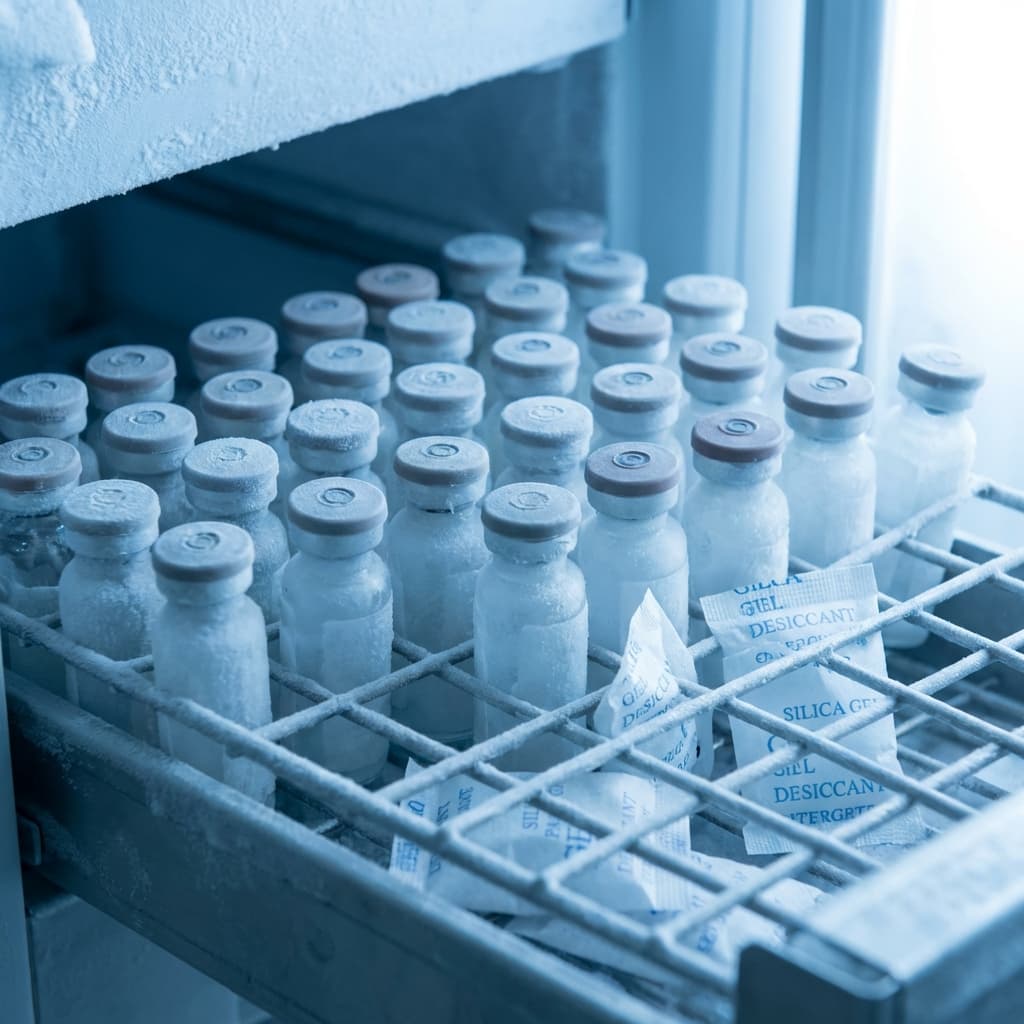
Peptides are inherently metastable molecules. Their secondary and tertiary structures are held together by relatively weak non-covalent interactions that are susceptible to entropy. Maintaining the "Cold Chain" is the primary defense against hydrolysis, oxidation, and deamidation—the chemical killers of research samples.
🔬 High-Performance Liquid Chromatography (HPLC) Standards
Clinical-grade storage ensures that the peptide's purity (often <98% HPLC) does not drop due to environmental stressors. Even a 2% drop in purity represents significant chemical degradation.
Stability varies drastically between the lyophilized (freeze-dried) state and the reconstituted state. Use the tool below to visualize how temperature alters the chemical half-life of your research assets.
🌡️ Peptide Stability Simulator
⚠️ The Room Temperature Trap
While most lyophilized peptides are stable during 7-14 days of shipping at room temperature, long-term exposure causes cumulative "thermal stress." Once received, peptides should immediately be transitioned to long-term cold storage.
In their dry state, peptides are vacuum-sealed to prevent interaction with atmospheric oxygen and moisture.
Long-Term Archive Strategy
- -20°C to -80°C: Required for archives intended for use after 12 months.
- Darkness: Photodegradation (light damage) is a major risk for peptides containing sulfur-bearing amino acids. Store in amber vials or light-proof secondary containers.
- Humidity Control: Glass vials are slightly permeable over years. Using desiccant packs in your secondary storage container is a mandatory clinical standard.
Once a peptide is in solution, the "clock" begins. The addition of water enables hydrolysis, the process by which the peptide chain is physically broken apart.
The "Aliquot & Freeze" Maneuver
If you do not plan to use the entire vial within 28 days, divide the reconstituted solution into single-dose syringes immediately. Freeze these syringes at -20°C. Thaw ONE syringe per use. This prevents the damaging "freeze-thaw cycle" of the main vial.
🚫 Freeze-Thaw "Shearing"
Do not repeatedly freeze and thaw a large vial of reconstituted peptide. The expansion of water crystals creates physical "shearing force" that can tear delicate peptide structures, rendering them biologically inert.
While microscopic degradation is invisible, advanced failure often presents with macro-signs:
- Aggregation: Reconstituted solution appears "snowy" or has white floating flakes (denatured protein).
- Coring: Small gray particles from the rubber vial stopper are visible in the liquid.
- Effervescence: Bubbling that does not settle quickly after reconstitution (potential microbial gas production).
💡 Professional Tip: "Vial Shielding"
Researchers often wrap vials in aluminum foil before placing them in the refrigerator to protect against the frequent light-cycles caused by opening the fridge door.