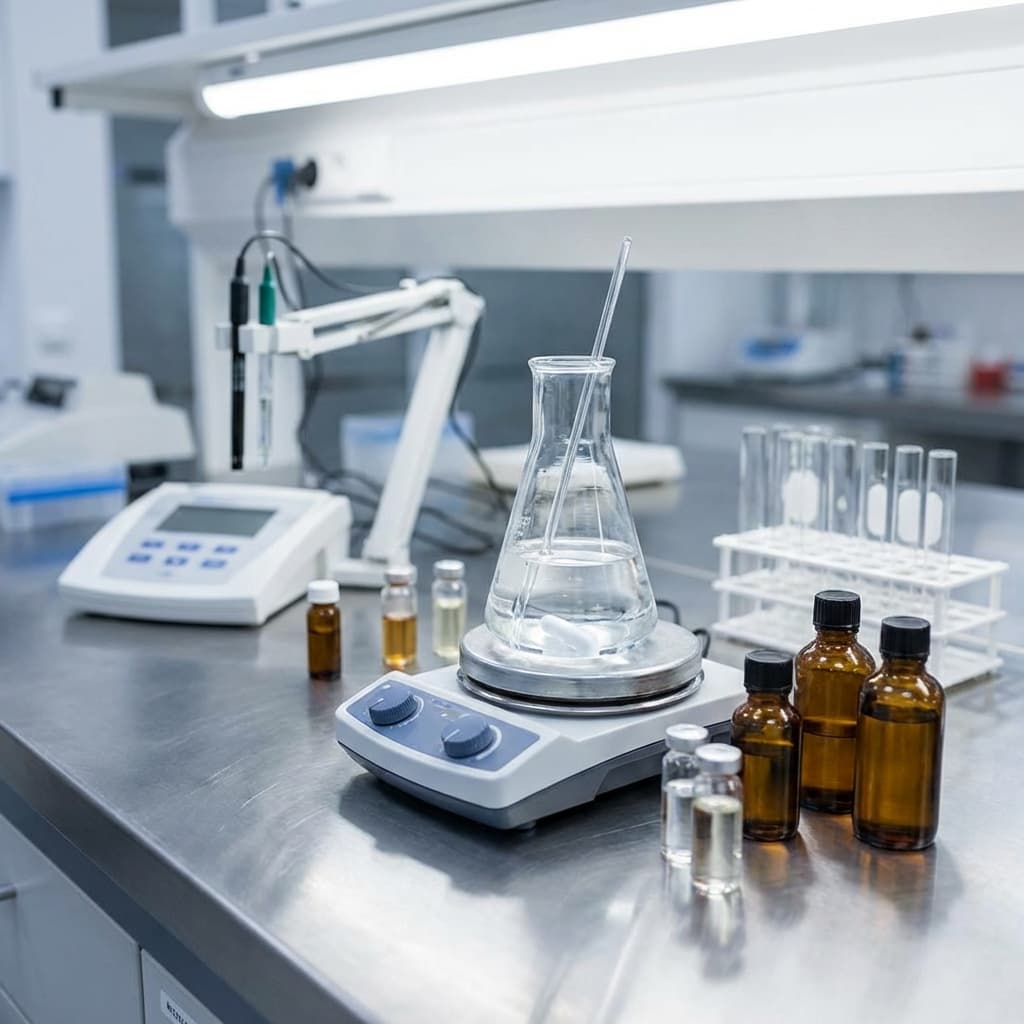
A common frustration in peptide research is the "cloudy vial." This is rarely a sign of impurity; rather, it is a consequence of molecular aggregation. Peptides often clump together via inter-chain hydrogen bonding or hydrophobic collapse, hiding their polar groups from the water solvent.
⚖️ The Isoelectric Point (pI) Hazard
Solubility is lowest at a peptide's pI, where its net charge is zero. Research solutions must be shifted away from this value to induce electrostatic repulsion—forcing the molecules apart and into the liquid phase.
Identify the chemical nature of your sequence to determine the most effective solvent intervention.
🧪 Solubility Strategy Advisor
Standard Solvation
Bacteriostatic Water + 10min Wait
Neutral sequences usually dissolve with time/gentle agitation.
⚠️ Shaking vs. Swirling
Never shake a peptide vial. Shaking generates high shear forces at the air-liquid interface, which can denature the peptide (denaturing it into white flakes). Only use gentle, horizontal "figure-eight" swirling.
Certain sequences, like many GH secretagogues, contain long chains of uncharged amino acids that actively repel Bacteriostatic Water.
The DMSO Bridge Protocol
- Aseptically add 50-100μL of sterile DMSO directly to the lyophilized puck.
- Wait 2 minutes for complete solvation (the solution will be crystal clear).
- Slowly dilute with BAC Water to your final volume.
- Keep final DMSO concentration below 10% to prevent cell-membrane irritation.
🔬 Sonication: The Nuclear Option
If chemical shifts fail, use an ultrasonic bath. 5-10 minutes of sonication at room temperature can physically shatter large molecular aggregates without damaging the primary peptide structure.
Distinguishing between "slow dissolving" and "permanently insoluble" is critical for research timing.
| Visual State | Diagnosis | Next Step |
|---|---|---|
| Hazy/Opalescent | Minor Aggregation | 10% Acetic Acid |
| White "Snow" Flakes | Denatured Protein | Discard Vial |
| Syrupy/Viscous | Gelation | Increase Solvent Vol |