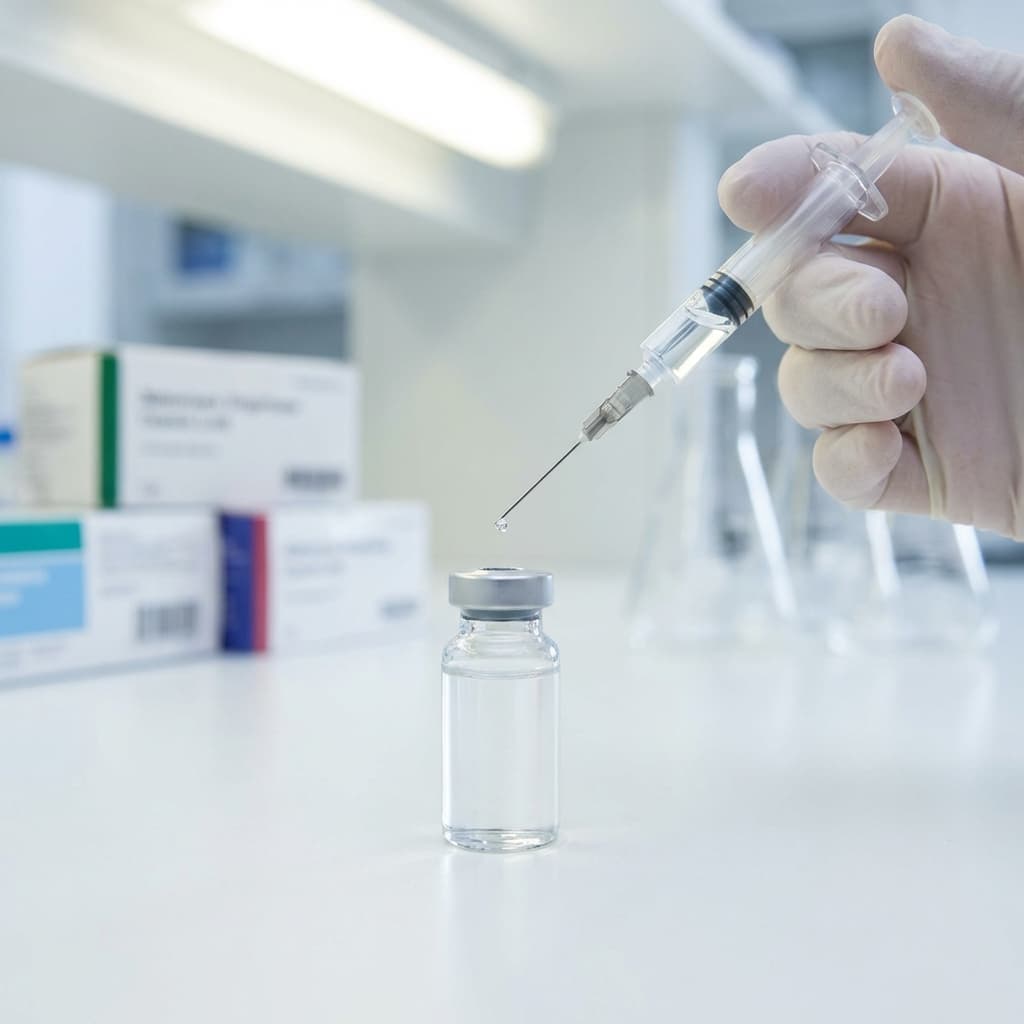
Bacteriostatic Water for Injection, USP, is sterile, non-pyrogenic water containing 0.9% benzyl alcohol (9 mg/mL) added as a bacteriostatic preservative. In peptide research, it serves as the universal medium for multi-dose applications, creating a chemical environment that inhibits the proliferation of high-risk microorganisms.
🔬 Bacteriostatic Definition
"Bacteriostatic" does not mean the water kills bacteria on contact (bactericidal). Instead, it prevents the reproduction of bacteria. This distinction is why sterile technique remains mandatory even when using BAC water.
Choosing between BAC water and preservative-free alternatives depends on your research duration and the specific chemical sensitivity of your peptide sequence.
| Solvent | Preservative | Stability | Best For |
|---|---|---|---|
| BAC Water | 0.9% Benzyl Alcohol | Multi-dose (28 days) | 95% of Peptides |
| Sterile Water | None | Single-dose (24h) | Sensitive/Neonatal |
| Normal Saline | None (usually) | Single-dose | Certain hydrophobic |
⚠️ Neonatal & Gaspping Syndrome WARNING
Bacteriostatic water containing benzyl alcohol is contraindicatedfor use in newborns and infants. It has been associated with "Gasping Syndrome," a fatal condition in neonates. For research involving primary neonatal cells or tissues, only preservative-free Sterile Water should be used.
Per the United States Pharmacopeia (USP) General Chapter <797>, once a multi-dose vial is punctured, the benzyl alcohol begins to oxidize, and its inhibitory effectiveness decreases. Furthermore, each puncture introduces a risk of needle-core fragmentation and cumulative microbial load.
🕒 USP <797> Expiry Tracker
Enter the date you first punctured the BAC water vial to calculate the mandatory discard date.
🚫 Visual Inspection Failure
Never use BAC water—reconstituted or otherwise—if it exhibits any cloudiness, particulates, or a "yellowish" tint. These are indicators of chemical oxidation or advanced microbial contamination.
Primary Storage
- Temperature: Store unpunctured vials at controlled room temperature (20-25°C).
- No Freezing: Never freeze BAC water. Freezing can lead to vial fracture or separation of the benzyl alcohol from the aqueous phase.
- Light Protection: Benzyl alcohol is mildly photosensitive; store in darkness.
The Puncture Protocol
- Mechanical Swab: Friction-scrub the rubber stopper for 15 seconds with 70% IPA alcohol.
- Air Equalization: Draw the same volume of air into the syringe as the water you intend to extract.
- Bevel Up: Insert the needle at a 45-degree angle, bevel up, to minimize the "coring" of the rubber stopper.
💡 Reducing "Sting"
Benzyl alcohol can cause a transient stinging reaction during subcutaneous application. To minimize this, wait 60 seconds after swabbing to allow alcohol to fully evaporate, and ensure the reconstituted peptide is at room temperature before application.
While BAC water is the modular standard, some highly sensitive peptides (e.g., GHRP-2, HGH Frag) may experience accelerated degradation if the pH deviates from the 4.5–7.0 range typical of BAC water.
- pH Sensitivity: Ensure your peptide is stable at the slightly acidic pH (~5.7) of standard BAC water.
- Concentration Limits: Do not attempt to reconstitute more than 20mg of peptide in 1mL of BAC water; the high solute concentration can interfere with the preservative's activity.