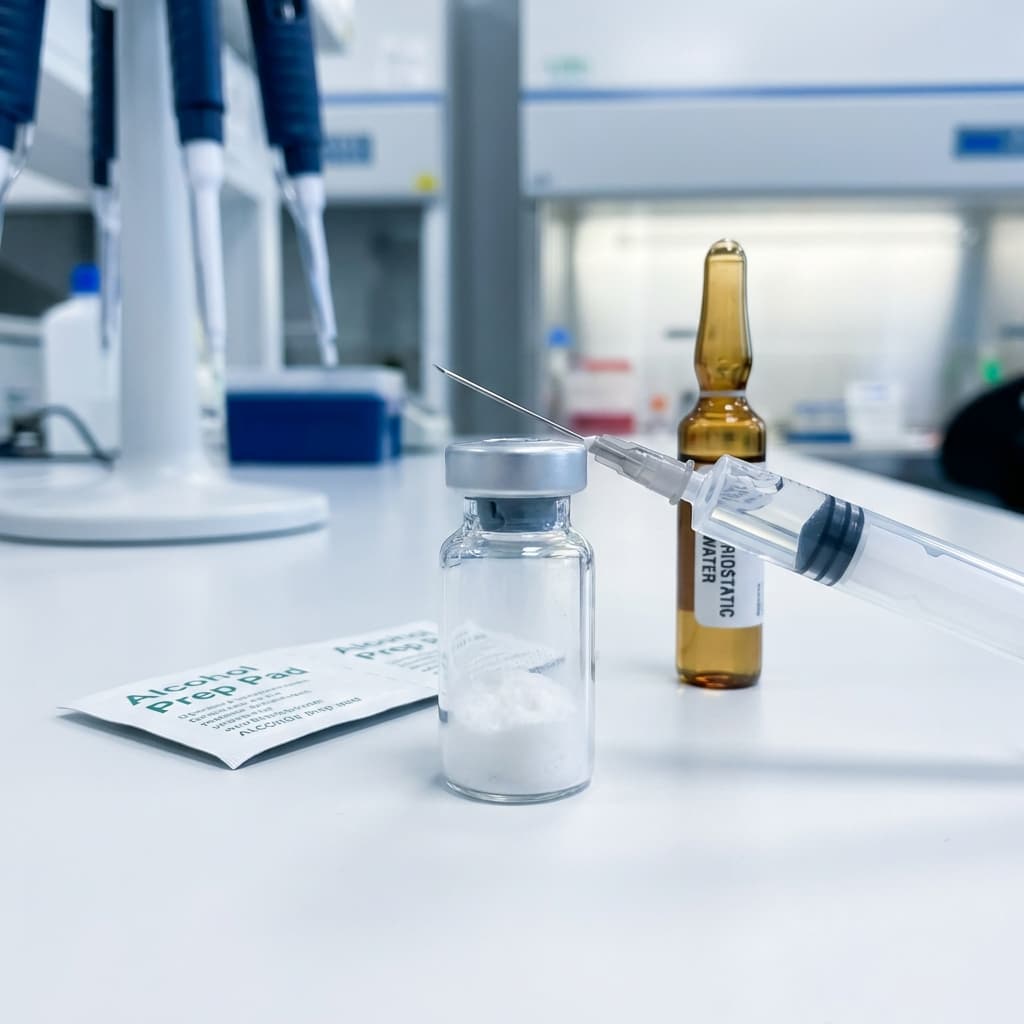
Peptide reconstitution is the delicate process of transitioning a highly unstable biological compound from a shelf-stable lyophilized (freeze-dried) state back into an aqueous (liquid) solution. In its powder form, a peptide is physically locked in a "cake" to prevent degradation. Reconstitution "awakens" the molecule, making it bioavailable for research applications.
🔬 Lyophilization Note
Lyophilized peptides are typically 98%+ pure. However, once dissolved, their stability timer begins. The rate of degradation is governed by temperature, pH, and light exposure.
Choosing the right solvent (diluent) is critical to maintaining peptide structure. Most research utilizes Bacteriostatic Water (BAC), but stubborn sequences may require pH-adjusted solvents.
BAC Water
Click to revealInitial choice for 95% of peptides. Contains 0.9% benzyl alcohol to prevent bacterial growth for up to 28 days of shelf life.
Acetic Acid (0.1%)
Click to revealCritical for BASIC peptides (positive net charge). If a peptide clumps in water, a few drops of 0.1% Acetic Acid often forces dissolution.
NaOH (0.01M)
Click to revealUsed for ACIDIC peptides (negative net charge). Deprotonates residues to increase solubility in stubborn sequences.
DMSO (Organic)
Click to revealLast resort for extremely hydrophobic peptides. Use 100% DMSO for initial dissolution, then dilute to <10% with aqueous solvent.
⚠️ The 28-Day Rule
Bacteriostatic water contains 0.9% benzyl alcohol as a preservative. Per USP guidelines, once a multi-dose vial is punctured, it must be discarded after 28 days, even if significant volume remains.
Concentration is the ratio of peptide mass (mg) to solvent volume (mL). Accurate math is the foundation of reproducible research. Use the interactive calculator below to plan your protocol.
🧮 Reconstitution Calculator
Directly squirting solvent onto a peptide cake can cause local shear forces that denature(break) the sensitive peptide chains or cause excessive foaming. Professional researchers use the Wall-Flow Method for maximum integrity.
Angle the Vial
Hold the peptide vial at a 45-degree angle.
Aim for the Glass
Position the needle so the tip touches the upper inside wall of the glass, not the powder.
Gravity Drip
Slowly release the solvent so it runs down the wall like a "waterfall," hydrating the cake from the bottom up.
The Silent Rest
Let the vial sit undisturbed for 1-5 minutes to allow full capillary action to penetrate the lyophilized cake.
✅ Proper Dissolution Indicators
A successful reconstitution results in a solution that is crystal clear and colorless. Any remaining "specks," "floaters," or cloudiness indicates incomplete dissolution or peptide aggregation.
If your solution remains cloudy after 15 minutes of resting, do not shake the vial. Instead, systematically apply these corrective measures based on the peptide's chemical nature.
Issue: Cloudy / Particulates
Fix: Allow to rest at 4°C for 2 hours. Often, "stubborn" sequences just require more time to hydrate.
Issue: Gel-Like Consistency
Fix: Increase solvent volume. The peptide has reached its saturation limit at the current concentration.
Issue: Clumping (Basic Peptide)
Fix: Add 2-3 drops of 0.1% Acetic Acid. This lowers the pH and forces basic residues into solution.
Once liquid, peptides are susceptible to bacterial growth and thermal degradation.
- Temperature: Maintain strictly between 2°C and 8°C (Refrigerated).
- Light: Store in the dark. UV light breaks peptide bonds in aromatic residues (Trp, Tyr).
- Agitation: Avoid unnecessary movement. Never store in a refrigerator door, as the motion of opening/closing can cause mechanical stress.
- Freeze-Thaw: Never re-freeze a reconstituted solution.