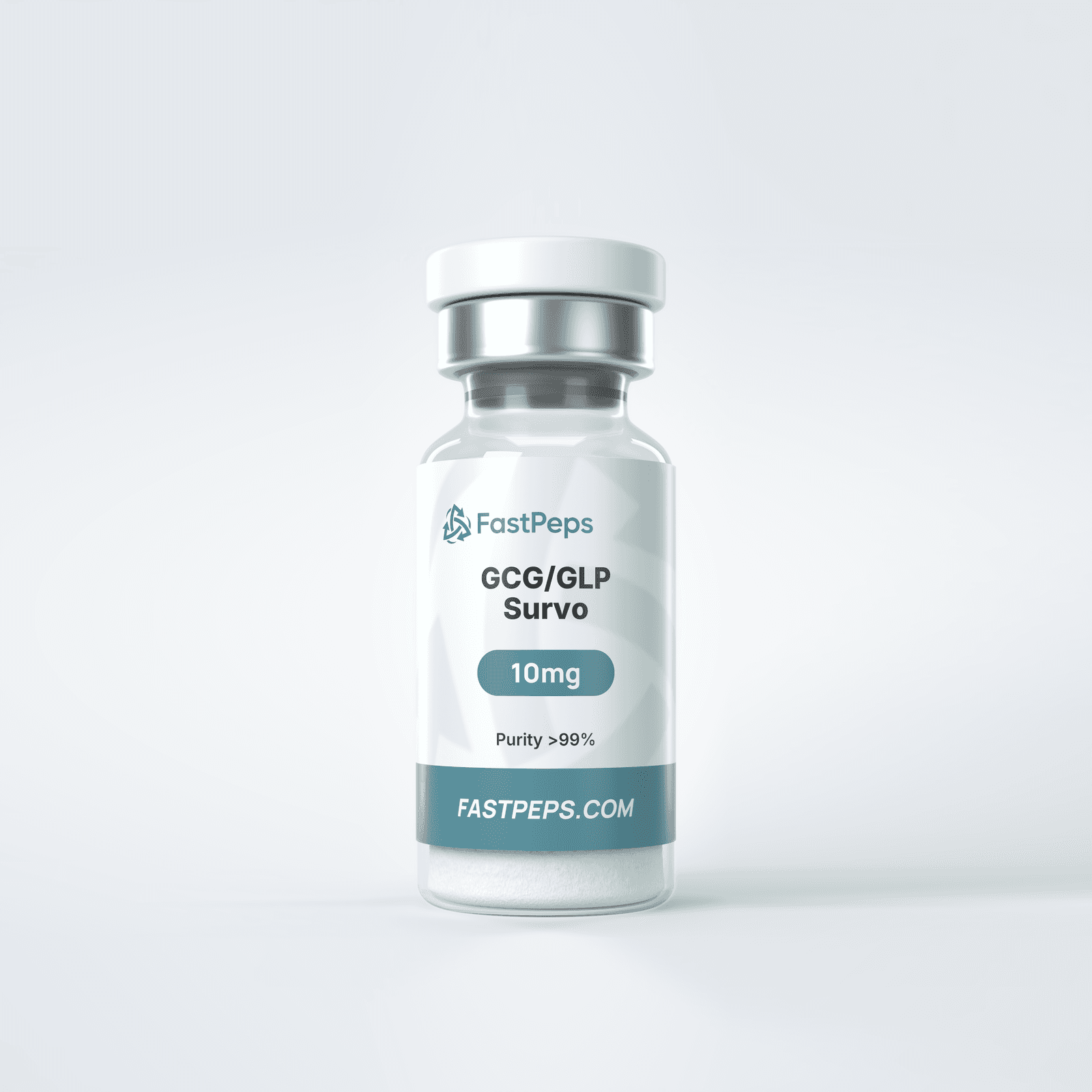
GCG/GLP Survo
A dual GLP and glucagon receptor agonist studied in metabolic research.

For research and educational purposes only. PepTalk discusses what researchers study in laboratory settings, not medical advice.
The short version
Survo is a single peptide built to activate two metabolic hormone receptors at once: GLP-1 and glucagon. That second pathway sets it apart from the incretin compounds most people know. Instead of the GIP receptor that the dual- and triple-agonists use, Survo pairs GLP-1 with glucagon, a combination researchers study for how the two signals work together in liver metabolism in animal models. It's an earlier-stage, investigational compound that has entered human clinical research.
What researchers are looking at
Metabolism is coordinated by a set of gut and pancreatic hormones. Most research compounds in this space lean on the GLP-1 messenger, sometimes paired with a second one called GIP. Survo takes a different route: it pairs GLP-1 with glucagon instead, and that pairing is the part researchers find most interesting.
The two arms act on different receptors. The GLP-1 side is the familiar one, the same receptor used across incretin research. The glucagon side is the novel addition: the glucagon receptor sits mainly in the liver, and in animal models researchers study how activating it changes liver metabolism and how cells use energy. That liver angle is why a large part of Survo's research sits in liver metabolism models.
Because Survo is earlier in the pipeline than the incretin leaders, most of the published mechanism work comes from animal and lab models, and it has also entered human clinical research. The findings are best read as what researchers observe in these models rather than proven outcomes. Its unusual dual-receptor design is what keeps it under active scientific attention.
GLP-1 pathway
Activates the GLP-1 receptor, the same receptor familiar from incretin research.
Glucagon pathway
Adds the glucagon arm, which acts on the glucagon receptor found mainly in the liver and is studied in animal models of liver metabolism.
Liver metabolism focus
The two arms together are studied in animal models of liver metabolism, the research area that sets Survo apart from GLP-1-only compounds.
Where the evidence stands
an honest mapDual-receptor mechanism characterized in animal & lab models
Has entered human clinical research
From the lab toward the clinic
Survo has entered randomized human clinical research, which is unusual for a compound this early in the pipeline. It remains an investigational compound, earlier-stage than the incretin leaders.
At a glance
What it is
A dual-agonist peptide
GLP-1 + glucagon
Studied for
Metabolic research
What sets it apart
Glucagon arm
not the GIP others use
Research stage
Investigational
Phase 2 underway
How it arrives
Lyophilized powder
Ships freeze-dried for stability and shelf life. Before research use, it's reconstituted with bacteriostatic water.
Bacteriostatic water
Needed to reconstitute
Certificate of analysis
Common questions
All products on FastPeps are labeled Research Use Only (RUO), and this is a legal requirement, not just fine print. It means these compounds are sold strictly for scientific research and laboratory purposes, not for personal use, self-administration, or medical treatment. This label exists because these compounds have not completed the FDA approval process to be sold as drugs or supplements. When you purchase from FastPeps, you are agreeing the product is for research purposes only.
For laboratory and research use only. Sold exclusively for in-vitro research and laboratory experimentation. Not a drug, supplement, or article intended for human or veterinary use; nothing here is medical advice or a claim of therapeutic benefit. Statements describe findings from published research.
Your Reliable Source for High-Quality Research Peptides
FastPeps is more than just a trusted U.S. supplier of research peptides. We are a catalyst for scientific advancement, dedicated to providing the highest quality peptides that empower our clients to push the boundaries of research.